Research
Research at Mango Languages
Discover the science behind Mango Languages.
Efficacy study
Our methodology, put to the test
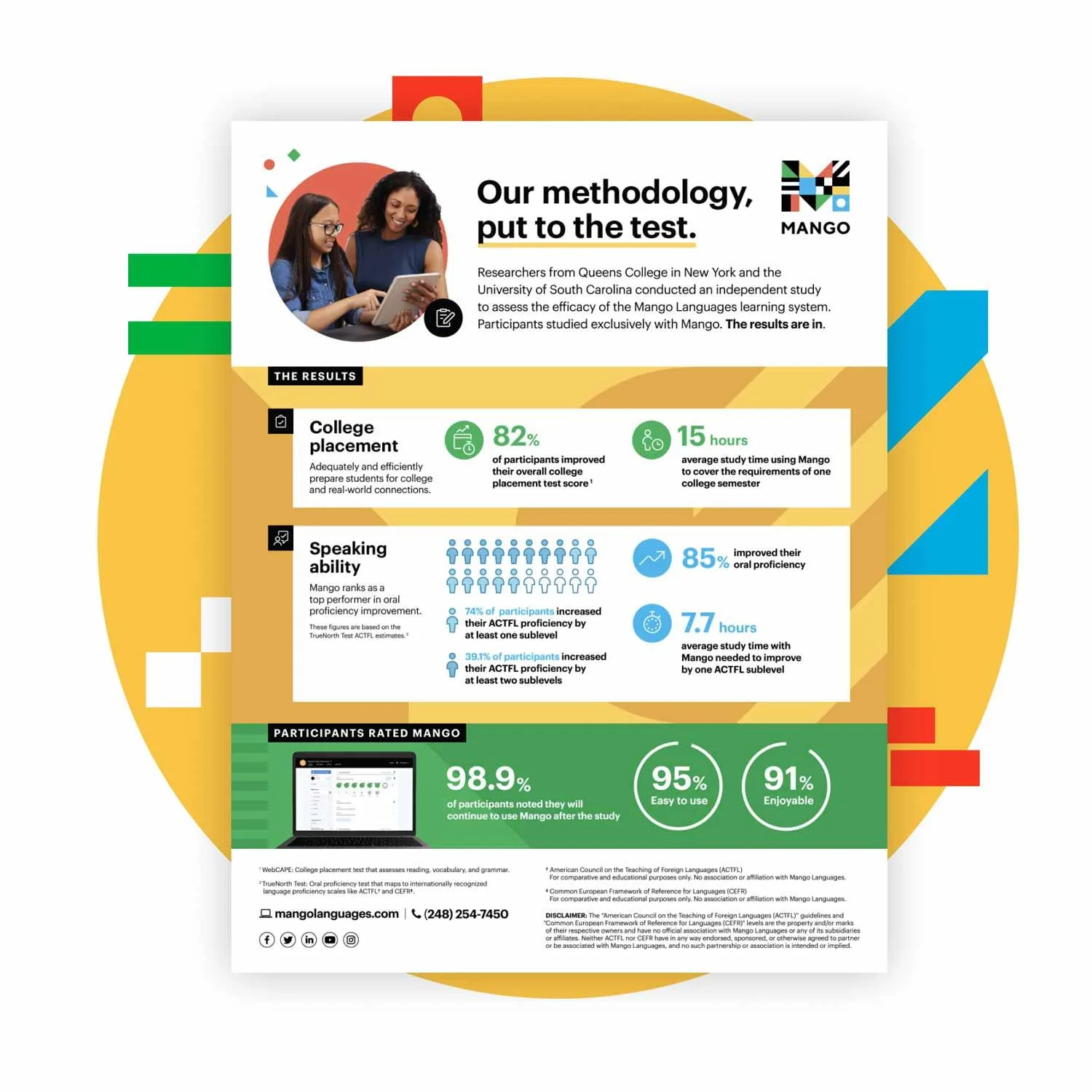
Researchers at Queens College, City University of New York, and the University of South Carolina conducted an independent study to assess the efficacy of Mango's learning system.
Who took part: 95 adults in the United States, aged 21 to 66, all self-reported novice learners of Spanish, who studied with Mango exclusively for two months.
Written proficiency was measured with the WebCAPE college placement test; oral proficiency with the TrueNorth Test, which produces estimated ACTFL and CEFR levels.
Whole sample
What every participant gained
Across all 95 participants.
improved their written proficiency
- 82%
measured with the WebCAPE college placement test
increased their oral proficiency
- 77%
measured with the TrueNorth Test
of study, on average, over two months
- 15 hours
to cover the requirements of a first college semester of Spanish (95% confidence interval: 12–20 hours)
Oral proficiency
Among learners who put in eight hours or more
Among the 46 participants who studied for eight hours or more:
increased their TrueNorth oral proficiency score
- 85%
raised their estimated ACTFL level by at least one level
- 74%
by up to four levels (95% confidence interval: 59.6–84.4%)
raised their estimated CEFR level
- 72%
The study covered adult learners of Spanish, so it doesn't tell you what to expect in another language or with younger learners.
Learner sentiment
What participants said about it
Self-reported at the end of the study, alongside the proficiency testing.
found it easy to use
- 95%
found it enjoyable
- 91%
found it helpful
- 88%
Net Promoter Score
- +42
Publications
The research library
The publications below include in-house white papers detailing the research that informs our products, along with research studies demonstrating product efficacy and user behaviors conducted by independent researchers or in collaboration with our research team.
- Independent study
2019
Mango Languages Efficacy Study: Final Report
Roumen Vesselinov, PhD & John Grego, PhD · Independent study: Queens College, City University of New York, and the University of South Carolina
Ninety-five US adults, all self-reported novice learners of Spanish, studied with Mango exclusively for two months. Written proficiency was measured with the WebCAPE college placement test and oral proficiency with the TrueNorth Test.
Note: Spanish only, adult learners only. Several headline figures apply to the subgroup who studied eight hours or more, not to the whole sample.
 Written by Mango
Mango Languages and Our Approach to Second Language Acquisition
Anja Green, Linguist Manager, Mango Languages · Whitepaper
How Mango's methodology draws on second language acquisition research: Krashen's Affective Filter and Input hypotheses, Communicative Language Teaching, and the five skills of speaking, listening, reading, writing and culture.
 Written by Mango
The Mango Curriculum: An All-in-One Solution for K-12 Language Classrooms
George Smith & Kaitlyn Tagarelli · Whitepaper
The design of Mango's K-12 curriculum and how it maps to state and national world language standards, including ACTFL's World-Readiness Standards for Learning Languages.
 Peer-reviewed · Mango co-author
2024
Acceptance and engagement patterns of mobile-assisted language learning among non-conventional adult L2 learners: A survival analysis
Hyun-Bin Hwang, Matthew D. Coss, Shawn Loewen & Kaitlyn M. Tagarelli · Studies in Second Language Acquisition, 46, 969–995
A survey of 3,670 adult app-based language learners, paired with their actual usage histories, asking why attrition is so high in mobile-assisted language learning and what distinguishes learners who keep going.
Note: Co-authored by a member of the Mango Languages team.
 Peer-reviewed · Mango co-author
2025
Acceptance and use of app-based language learning among young adolescents in a self-directed context
Hyun-Bin Hwang · TESOL Quarterly
297 South Korean middle-school students aged 12 to 13 were given voluntary access to Mango's English course outside class. Completion ranged from zero to 92 lessons. Students who saw the app as useful, and who felt supported by their teachers in using it, did substantially more.
Note: The author is a past recipient of Mango's dissertation award.
Methodology
What Mango is built on
Mango's methodology, Intuitive Language Construction™, comes out of second language acquisition research rather than from a content plan. Two of Krashen's ideas do most of the load-bearing work: the Affective Filter Hypothesis, which is why lessons are built to be low-stakes enough that a learner will risk speaking, and the Input Hypothesis, which is why material sits a step beyond where the learner currently is instead of well beyond it.
The lessons themselves follow Communicative Language Teaching, every chapter opens with a real conversation in the target language and works outward from it. And we teach five skills rather than the traditional four: speaking, listening, reading, writing, and culture, because cultural literacy is part of understanding what someone means.
Our course and classroom guides are organized around ACTFL's Five Cs: Communication, Cultures, Connections, Comparisons and Communities, and the World-Readiness Standards for Learning Languages. You can read the full account in our whitepaper on second language acquisition.
"The American Council on the Teaching of Foreign Languages (ACTFL) guidelines" and "Common European Framework of Reference for Languages (CEFR) Levels" are the property and/or marks of their respective owners and have no official association with Mango Languages or any of its subsidiaries or affiliates. Neither ACTFL nor CEFR have in any way endorsed, sponsored, or otherwise agreed to partner or be associated with Mango Languages, or the Mango Languages Proficiency Scale, and no such partnership or association is intended or implied.
Research Initiatives
Collaboration & Findings
Dissertation Awards
Each year, Mango recognizes exceptional dissertation research at the intersection of language learning and educational technology.
See the awardsResearch collaboration
Our Research team works closely with academic partners to answer important questions about language learning technology.
Work with usProficiency levels
How the Mango Proficiency Scale maps to the ACTFL and CEFR frameworks, level by level.
See the scaleSee it in practice
Schools, libraries, and companies on what changed after they rolled Mango out.