In Japanese, 〜とき transcribed toki is used a lot like “when.” Using it lets you add time-related information to a statement.
However, 〜とき-structures in Japanese have some unique features that Japanese learners should be aware of. In this article we’ll find out when and how to use 〜とき in Japanese sentences, how 〜とき interacts with different tenses, and when to follow a 〜とき phrase with a particle.
Are you ready to kick your Japanese up a notch by getting familiar with this new expression? Let’s get started!
What does 〜とき [toki] mean in Japanese?
In Japanese, 〜とき transcribed toki is often translated as “when,” but it is grammatically a noun, meaning something more like “time.”
とき transcribed toki can be used to literally refer to “time,” but it sounds a bit old-fashioned or poetic. In modern day, we usually use the word 時間 transcribed jikanmeaning time instead.
時を知らせる鐘の音Transcription: toki o shiraseru kane no otoTranslation: the sound of the bells that tell timeIn modern Japanese, とき transcribed toki is more often used as a formal noun or 形式名詞 transcribed keishiki meishi: a word that is technically a noun, but has a more grammatical function. In this use, it means “during the time that…” or “at the time that…”, two phrases that can both be replaced by the word “when.”
18歳になったときTranscription: jūhassai ni natta tokiTranslation: when I turned eighteen…at the time that…子供のときTranscription: kodomo no tokiTranslation: when I was a child…during the time that…Notice that とき transcribed toki does not work as a question word, so don’t use it to ask “when” questions!
How to use とき [toki] to mean “when”?
Where the English word “when” starts the clause it works with, its Japanese equivalent follows it.
As we said above とき transcribed toki is a noun meaning “time,” and so the clause that it works with is actually a relative clause that describes that time. So a more literal translation of the second example might be something like:
This means it must follow the grammar of a relative clause and generally takes the plain form.
Plain form
Have a look at the examples below. Notice that the relative clause can take on a range of different plain forms, but its subject is generally marked by が transcribed ga. Check out this summary of the plain form of Japanese verbs, adjectives, and noun + だ transcribed da combinations.
| Predicate Type | Normal Clause | Relative Clause + とき |
|---|---|---|
Verb | ラーメンを食べます。 Transcription: Rāmen o tabemasu. Translation: I eat ramen. polite affirmative form | ラーメンを食べるとき Transcription: rāmen o taberu toki Translation: when I eat ramen plain affirmative form |
メールが来ません。 Transcription: Mēru ga kimasen. Translation: The email doesn’t come. polite negative form | メールが来ないとき Transcription: mēru ga konai toki Translation: when the email doesn’t come plain negative form | |
雪が降っています。 Transcription: Yuki ga futteimasu. Translation: It’s snowing. polite progressive form | ||
寒いです。 Transcription: Samui desu. Translation: It is cold. | 寒いとき Transcription: samui toki Translation: when it is cold plain affirmative form | |
ひまじゃありません。 Transcription: Hima ja arimasen. Translation: We are not free. | ひまじゃないとき Transcription: hima ja nai toki Translation: when we are not free plain negative form | |
子供でした。 Transcription: Kodomo deshita. Translation: You were a child. |
Where to put 〜とき [toki] clause in a Japanese sentence?
In Japanese, a part of the sentence that ends with 〜とき transcribed toki, let’s call it as the “〜とき clause”, always comes before the main clause in a sentence. This means the 〜とき clause precedes the situation that it describes.
Unlike a “when” clause in English, a 〜とき transcribed toki clause can’t follow the situation it describes!
What tense to use with 〜とき [toki]?
A Japanese sentence with a 〜とき transcribed toki clause makes reference to two events or situations, each of which has a tense (or a placement in time). Let’s look at the rules!
Tense of the main clause
The tense in the main clause is simple: it reflects when that main event you’re describing takes place compared to “now”:
Tense of the 〜とき [toki] clause
The tense of the 〜とき transcribed toki clause, on the other hand, depends on whether or not the situation in the 〜とき clause is finished or completed at the time when the main event takes place. The basic rule is:
Use the ta-form (broadly, the past tense) before とき if the 〜とき clause is already completed when the main clause takes place.
〜とき clause (ta-form)main clause (past)会社を出たとき、家に電話する。Transcription: Kaisha o deta toki, ie ni denwa suru.Translation: When I have left the office, I (will) call home.会社を出たとき、家に電話した。Transcription: Kaisha o deta toki, ie ni denwa shita.Translation: When I had left the office, I called home.So remember to use the past tense + とき to represent a situation like this:
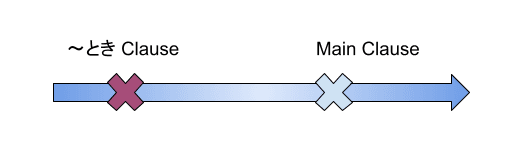
Use the present tense (dictionary form) before とき if the 〜とき clause is either incomplete at the time the main clause happens, or is completed at the same time as the main action.
This means the sentences below can have a number of different interpretations:
〜とき clause (present)main clause (present)会社を出るとき、家に電話する。Transcription: Kaisha o deru toki, ie ni denwa suru.incomplete
While I am leaving the office, I call home.While I am leaving the office, I will call home.at the same time
At the moment I leave the office, I call home.At the moment I leave the office, I will call home.〜とき clause (present)main clause (past)会社を出るとき、家に電話した。Transcription: Kaisha o deru toki, ie ni denwa shita.incomplete
While I was leaving the office, I called home.at the same time
At the moment I left the office, I called home.So remember to use the present tense + 〜とき to represent either of the following situations:
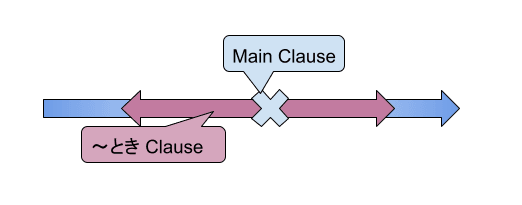
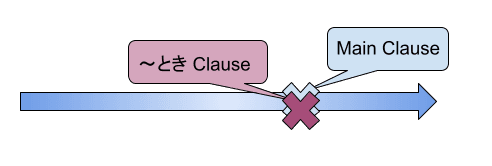
Does the tense of the 〜とき [toki] clause always matter?
No, the tense of the 〜とき transcribed toki clause does not always impact the meaning of a sentence.
Usually, this happens when the main clause represents an ongoing situation or state rather than a single point in time. In these situations, it doesn’t matter much whether you use present tense + 〜とき or past tense + 〜とき.
The tense of the 〜とき clause doesn’t matter, for example, when the main clause is constructed around:
A conjugated adjective
A noun + だ transcribed da
A stative verb, like いる transcribed irumeaning to exist or ある transcribed arumeaning to exist
〜ている transcribed ...teirumeaning ...ing form of a verb
However, when the main action is in the past tense, and represents a continuous action like 来る transcribed kurumeaning to come, 行く transcribed ikumeaning to go, and 話す transcribed hanasumeaning to talk, the tense in the 〜とき clause also doesn’t matter, as long as the two continuous actions take place at the same time.
とき [toki] vs. ときに [toki ni] vs. ときには [toki ni wa]
Because 〜とき transcribed toki is a noun, it can be marked by the same particles that usually mark nouns: most commonly the time particle に transcribed ni, the topic marker は transcribed wa, or both. Let’s see what subtle difference the little addition can make.
〜とき transcribed toki is the basic form we’ve been introduced to above.
子供のとき、よく病気した。Transcription: Kodomo no toki yoku byōki shita.Translation: I used to get sick often when I was a child.〜ときに transcribed toki ni is the basic form followed by the time particle に transcribed ni. We add に transcribed ni to a 〜とき clause to lightly imply or emphasize that the main event probably only happened one time.
子供のときに、はしかにかかった。Transcription: Kodomo no toki ni, hashika ni kakatta.Translation: When I was a child, I got measles.a one-time eventに transcribed ni, however, can be omitted in everyday conversations, and the difference in nuance may not show up in the English translation.
〜ときには transcribed toki ni wa is a combination of the base form 〜とき + the particle に transcribed ni + the topic marker は transcribed wa. You might use this combination in a context where you might begin an English sentence with a phrase like “as for when…” or “speaking of when….”
子供のとき(に)は、寒さがあまり気にならないものだ。Transcription: Kodomo no toki (ni) wa, samusa ga amari ki ni naranai mono da.Translation: When you are a child, you don’t mind the cold so much.This sentence must include は transcribed wa if you want it to represent a general observation.Note that に transcribed ni is often omitted from this combination, in everyday conversations, but は is essential if you want to achieve this meaning.
To sum up
In this post, we talked all about how to use 〜とき transcribed toki to mean “when” in Japanese. Here are the most important points to remember:
〜とき is often translated as “when” but it literally means “the time” and always comes after a relative clause or other noun-modifying phrase.
The 〜とき clause always comes before the main clause.
Remember these tense rules:
The tense of the main clause reflects when it happened compared to “now.”
The tense of the 〜とき clause tells you whether the 〜とき clause was…
finished before the main event → past tense
happening at the same time as the main event → present tense
But remember that when the main clause describes a long-term situation the tense of the 〜とき clause doesn’t matter!
Ready to practice? Check out our 〜とき transcribed toki activities to test your skills! Or, look at the plain form reference sheet to review the forms of the words that can precede 〜とき!
:quality(80))
:quality(75))
:quality(75))
:quality(75))
:quality(75))
:quality(75))
:quality(75))
:quality(75))
:quality(75))