Check out our post on “unagi sentences” (or “eel sentences”) in Japanese to see a really good illustration of how this contrasting effect works in a conversation!

Japanese Articles
What is the difference between は (wa) and が (ga) in Japanese?
By: Saeko Kitamae Tue Jun 09 2026
The basic difference between は[wa] and が[ga] in Japanese is that は[wa] marks the topic, while が[ga] usually marks new information.
は[wa] | が[ga] |
|---|---|
Narrows an old topic of discussion | Introduces new information |
Translations:
| Translations:
|
Implies contrast | Implies an exhaustive answer |
Used after the topic of a sentence | Used after question words Used after the subject of a subordinate clause |
This can be an especially tricky distinction for Japanese learners, because the difference lies not in the literal meaning of a sentence, but in how that sentence “slots into” the surrounding context. If you look at a single sentence in translation, it can be very tricky to tell why は[wa] is used in one sentence and が[ga] in another:
ジョンは先生です。
Jon wa sensei desu.
John is a teacher.
メアリーは綺麗です
Mearii wa kirei desu.
Mary is beautiful.
子供たちが泳いでいます。
Kodomotachi ga oyoide imasu.
Children are swimming.
雨が降っています。
Ame ga hutte imasu.
It is raining.
lit. Rain is falling.
These two little words are all over in Japanese, though, so understanding how and when to use each one is an essential part of learning the language!
In this post, we’ll talk first about the main contexts when you should use は[wa], then about the main uses of が[ga]. We’ll then talk through some exceptions and special cases. Ready to get started? Let’s dive in!
What are は [wa] and が [ga] in Japanese?
The Japanese words は[wa] and が[ga] are function words belonging to a group of words we call particles. In Japanese, particles are small helper words that we use alongside another word, like a or , that tell us something about the role it plays in a sentence.
There are a lot of particles in Japanese, but は[wa] and が[ga] are some of the most common and trickiest to master. Let’s have a closer look!
When to use は [wa] in Japanese?
In Japanese, we use the word は[wa] after the topic of a sentence, which is usually something already part of the conversation or context that we want to “narrow in on” for some reason. For example:
topictopic marker
昼ごはん は食べました。
Hirugohan wa tabemashita.
(As for) lunch, I ate.
→ We were broadly discussing meals and eating, but I want to specifically talk about lunch.
Let’s look a little more closely at what a “topic” is by looking at some English examples.
What is a grammatical “topic”?
A topic is a noun that might follow a phrase like “speaking of…” or “as for…” or “regarding…” or “on the matter of…” in English.
topic
(As for) job applications, I never seem to have any luck.
(As for) that tree, its flowers are beautiful.
(As for) the book, I read it yesterday.
In the sentences above, the topic noun and the subject noun are different. However, it’s possible for them to be the same. In English, we often don’t separate out the topic in cases like these, but you can tell that the subject is the topic because it makes sense to rephrase the sentence using a phrase like “as for…” or “regarding…”.
topic and subjecttopicsubject
Mary’s father will join us. → (As for) Mary’s father, he will join us.
The washing machine is quiet. → (As for) the washing machine, it is quiet.
However, not every sentence has a topic. For example, you wouldn’t use “as for…” or “regarding…” to rephrase the sentence below:
subject
Three men are approaching the building!
→ These three men are not an established topic, they are new to the conversation and we are surprised to see them here. This is a subject that is not a topic.
If what is expressed by the subject is identified beforehand, it is the topic. If not, it is not the topic. Again, a subject can be the topic, but it is not always the topic.
How to use は [wa] as a topic marker in Japanese?
In Japanese, we most often use は[wa] as a topic marker by placing it after the topic and before the rest of a sentence.
topictopic marker
ジョンは先生です。
Jon wa sensei desu.
John is a teacher.
lit. (As for) John, (he) is a teacher.
メアリーは綺麗です。
Mearii wa kirei desu.
Mary is beautiful.
lit. (As for) Mary, (she) is beautiful.
Remember, though, that we only use は[wa] this way when Mary and John are topics, meaning they were already talked about beforehand.
Here are more examples:
topictopic marker
佐藤さんは学校に行きました。
Satō-san wa gakkō ni ikimashita.
(As for) Sato-san, (he/she) went to school.
その本 は昨日読みました。
Sono hon wa kinō yomimashita.
(As for) the book, I read (it) yesterday.
→ Notice that the topic is not the subject of this sentence!
昨日 は 早く起きました。
Kinō wa hayaku okimashita.
(As for) yesterday, I woke up early.
→ Notice that the topic is not the subject of this sentence!
How to use は [wa] to show a contrast?
In Japanese, we can use は[wa] both in sentences that are specifically intended to show contrast and to imply a contrast between one situation and other related situations.
Implied contrast with は [wa]
Most of the time, using は[wa] implies some sort of contrast, simply because you are calling attention to one noun to the exclusion of all others. Doing this can imply that other similar nouns would not be involved in the situation you’re describing.
topictopic marker
昨日は早く起きました。
Kinō wa hayaku okimashita.
(As for) yesterday, I woke up early.
→ Implies that though yesterday I woke up early, I probably do not always.
昼ごはんは食べました。
Hirugohan wa tabemashita.
(As for) lunch, I ate.
→ Implies that though I did eat lunch, I may not have eaten other meals.
数人は来ました。
Sūnin wa kimashita.
(As for) a few people, they came.
→ Implies that though I knew a few people came, some others may not have come.
私 は出来ませんでした。
Watashi wa dekimasen deshita.
(As for) me, I was not able to do it.
→ Implies I might be different from others. Maybe someone else could do it.
What if you don’t want to imply a contrast like this? You can always leave it out, or use a different particle. For example, if someone asks you “Did you have lunch?” you could reply without は[wa]:
食べました
tabemashita
(I) ate it.
Tip
Explicit contrasts with は [wa]
We also use the word は[wa] in sentences designed to show an explicit contrast. We use it here because we are shifting between two different topics: X vs. Y. Use this sentence pattern:
Topic 1
は
wa
Topic 2
は
wa
Description
私は20さいですが、弟は15さいです。
Watashi wa 20 sai desu ga, otōto wa 15 sai desu.
I am 20 years old, but (my) younger brother is 15 years old.
昼ごはんは食べましたが、朝ごはんは食べませんでした。
Hirugohan wa tabemashita ga, asagohan wa tabemasendeshita.
I ate lunch, but I didn’t eat breakfast.
パーティーに友達は行きましたが、私は行きませんでした。
Pātii ni tomodachi wa ikimashita ga, watashi wa ikimasendeshita.
(My) friends went to the party, but I didn’t go.
When to use が [ga] in Japanese?
In Japanese, we use が[ga] after a new piece of information we are introducing into a conversation. In grammar, we call this the “focus.” Let’s look at a couple examples!
You open a window without knowing it is raining. Then, finding it is raining, you might say:
new informationfocus markerあっ、雨が降っています。
A, ame ga futteimasu
Oh, it’s raining!
lit. Oh, rain is falling!
The rain is surprising and new. You would never start a sentence like this with “As for the rain…” or “Speaking of rain…” so in this context we use が[ga]!
You want your friends to know you’ve got a headache, so you say…
new informationfocus marker頭が痛いです。
Atama ga itai desu.
(My) head is painful.
In this context, you wouldn’t start with “As for my head…” or “Speaking of my head…” because no one was thinking about your headache before you informed them about the problem. It’s new to the conversation.
In the sentences above, the whole situation represents new information to the conversation. In sentences like this, you’ll usually just put が[ga] after the subject.
Things get a little more complicated, though, in a sentence where we have a mix of new and old information. Let’s look, now, at a longer example:
new informationfocus marker
アキラはレストランのオーナーです。シェフは、太郎とマリオとスラヴァンです。下の写真をみてください。 左が太郎です。 真ん中がマリオです。 右がスラヴァンです。太郎は寿司を作ります。マリオはピザを作ります。スラヴァンはカレーを作ります。
Akira wa resutoran no ōnā desu. Shefu wa, Tarō to Mario to Suravan desu. Shita no shashin o mite kudasai. Hidari ga Tarō desu. Mannaka ga Mario desu. Migi ga Suraban desu. Tarō wa sushi o tsukurimasu. Mario wa piza o tsukurimasu. Suraban wa karē o tsukurimasu.
Akira is a restaurant owner. As for the chief cooks, (they) are Taro, Mario, and Sravan. Please look at the picture below. On the left is Taro. In the middle is Mario. On the right is Sravan. As for Taro, [he] prepares sushi. As for Mario, [he] prepares pizza. As for Sravan, [he] prepares curry.
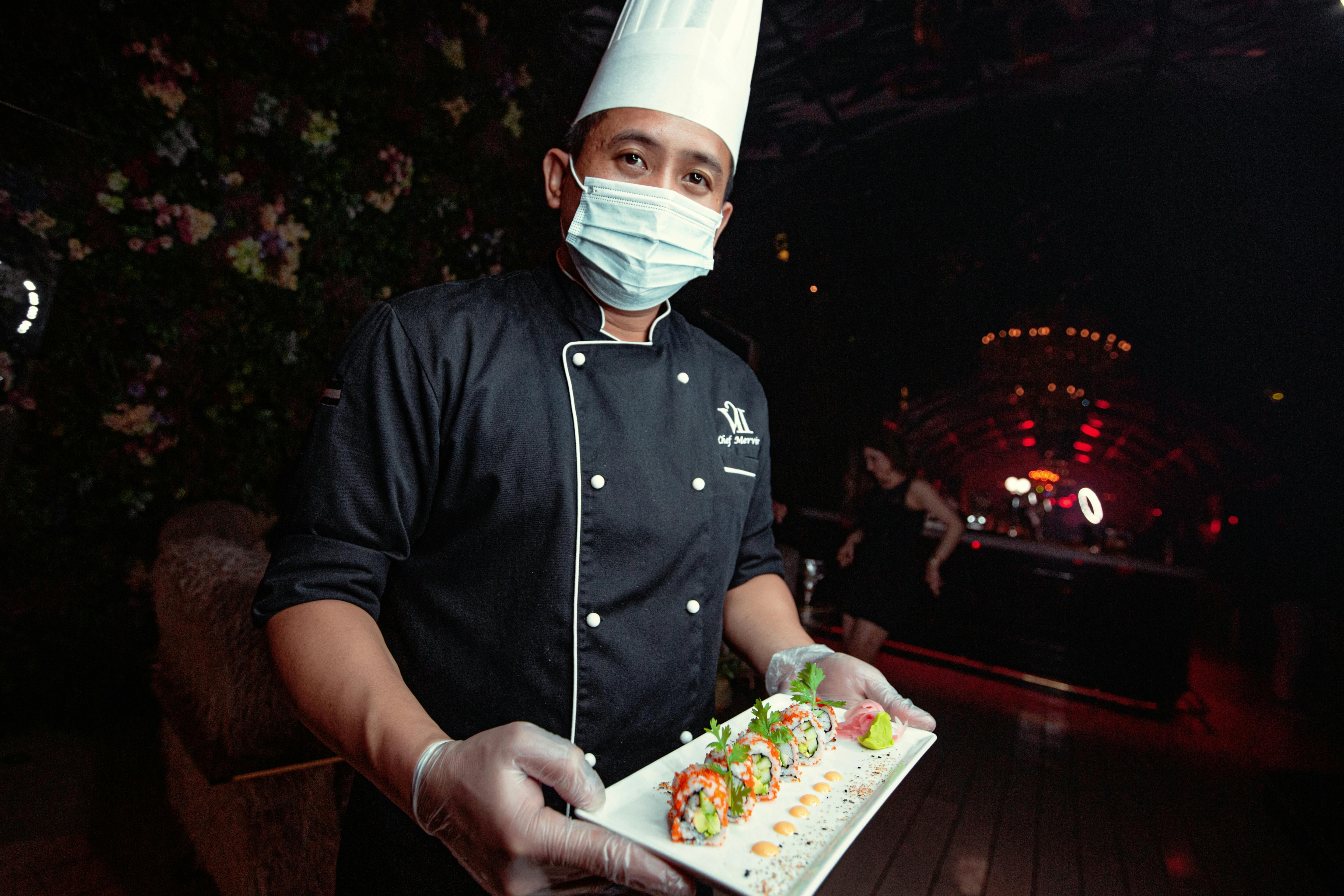


Have a look at the highlighted sentence in the passage above. What do you notice?
Because the names of the chefs, 太郎(Taro), マリオ(Mario), and スラヴァン(Sravan) were mentioned before the underlined sentences, those names are not new information, so they do not come before が[ga].
The new information in the highlighted sentence is the position of each chef’s picture: 左(on the left), 真ん中(in the middle), and 右(on the right). Therefore, it is these words that come before the focus particle が[ga]!
Tip
A sentence with the structure new information + が[ga] + old information can often be restructured to use は[wa] instead by just reversing the positions of the new and old information:
With が[ga] | With は[wa] |
|---|---|
new informationfocus markerold information 左が 太郎です。 On the left is Taro. | old informationtopic markernew information 太郎 は左です。 As for Taro, (he is) on the left. |
Be careful, though! You can’t do this swap if the whole sentence is new information!
With が[ga] | With は[wa] |
|---|---|
new informationfocus markerold information 雨が降っています。 It’s raining! | topic marker ❌ 降っているの は雨です。 As for what is falling, (it is) rain. → 降っているの is not old information! |
Swapping the order can also lead to some slightly different implications, too! We’ll discuss those below!
The basic function of が[ga], therefore, is to mark new information. There are, though, a few cases where you’ll use が[ga] in places where that might not be intuitive. Let’s go through these situations!
が [ga] in questions
In Japanese, use the word が[ga] in questions (after the question word) and in the answers to questions (after the answer).
Speaker A:
question wordfocus marker
だれが来ましたか。
Dare ga kimashita ka
Who came?
Speaker B:
answerfocus marker
山田さんが来ました。
Yamada-san ga kimashita.
Mr./Ms. Yamada came.
Using が[ga] in these situations is reasonable. Before hearing the answer, the person who came could not be identified. Marking such a word with は[wa] is against the rules.
An apparent exception: が [ga] to show surprise
が[ga] can also be used in a sentence to show that something has surprised you or contradicted your expectations. In this use it’s not technically following new information, but it’s information that still feels new, because it’s so surprising.
focus marker
Speaker A:
日本がワールドカップで優勝しました!
Nippon ga wārudokappu de yūshō shimashita!
Japan won the title at the FIFA World Cup!
Speaker B:
えっ、日本が?
E, Nippon ga?
Oh, Japan, really?
→ This speaker is so surprised that they think they’ve maybe misheard.
Here is another example:
focus marker
Speaker A:
鈴木さんが踊っています。
Suzuki san ga odotteimasu.
Mr./Ms. Suzuki is dancing.
Speaker B:
鈴木さんが?
Suzuki san ga?
Mr./Ms. Suzuki, really?
→ This speaker had no idea that Mr./Ms. Suzuki could dance, or would really never expect them to be dancing at this particular party!
An apparent exception: が [ga] in subordinate clauses
In Japanese, we always use が[ga] to mark the subject of a subordinate clause regardless of whether the noun it marks follows is technically “new information” to the conversation. We do this because the subordinate clause is “new information” about the main clause.
Let’s look at an example to explain what this means.
focus marker
シェフは、太郎とマリオとスラヴァンです。かれら が素晴らしいシェフなので、レストランは大人気です。
Shefu wa, Tarō to Mario to Suraban desu. Karera ga subarashii shefu nanode, resutoran wa daininki desu.
As for the chief cooks, (they) are Taro, Mario, and Sravan. Since they are great cooks, the restaurant is very popular.
The use of が[ga] in the second sentence might be surprising. Taro, Mario, and Sravan have already been mentioned in the conversation, so why is かれら(they) being marked as “new information”? Because it is the subject of a subordinate clause!
Let’s look more closely at that second sentence, so you can see what this means:
subordinate clause
かれらが素晴らしいシェフなので、レストランは大人気です。
Karera ga subarashii shefu nanode, resutoran wa daininki desu.
Since they are great cooks, the restaurant is very popular.
This sentence has two parts: a main , which is the central message of the sentence (the restaurant is very popular), and a subordinate clause, which completes or adds information about that main message. In this case it explains why the restaurant is popular.
In Japanese, we use が[ga] in subordinate clauses to indicate that the subordinate clause provides additional (new) information about the main clause. So though the chefs may not be new to the conversation, the fact that they are great cooks still provides “new information” in the context of the second sentence.
Here are a few more examples of が[ga] being used to mark the subject of a subordinate clause:
subordinate clausefocus marker
レストランが開店したとき、アキラはとてもうれしかった。
Resutoran ga kaiten shita toki, Akira wa totemo ureshikatta.
When the restaurant opened, Akira was very happy.
みなさんがわかるまで、説明します。
Minasan ga wakaru made, setsumeishimasu.
Until you understand, (I) will explain.
夏休みがはじまったら、何をしますか。
Natsuyasumi ga hajimattara, nani o shimasu ka.
When the summer holidays begin, what will (you) do?
How to use が [ga] in relative clauses?
Relative clauses are a type of subordinate clause that is used specifically to describe a noun. For example, in “the book that I read,” the phrase “that I read” is a relative clause, describing the book. Like other kinds of subordinate clauses in Japanese, が[ga] is involved in these as well!
In Japanese, relative clauses don’t have a linking word like “that” or “who” to connect the clause to the noun it modifies. Instead, we put a relative clause before the noun.
relative clausemodified noun
学生がかった本
gakusei ga katta hon
the book (that) the student bought
コーヒーがおいしいカフェ
kōhii ga oishii kafe
a cafe (where) the coffee is tasty
Notice that が[ga] appears after the subject of the relative clause!
subjectが
学生がかった
gakusei ga katta
(that) the student bought
コーヒーがおいしい
kōhii ga oishii
(where) the coffee is tasty
We use が[ga] this way even if the subject of the relative clause itself is old information. Let’s talk about those chefs again!
repeated informationfocus marker
シェフは、太郎と マリオとスラヴァンです。 マリオ が作るピザは、とてもおいしいです。
Shefu wa, Tarō to Mario to Suraban desu. Mario ga tsukutta piza wa, totemo oishii desu.
As for the chief cooks, (they) are Taro, Mario, and Sravan. As for the pizzas that Mario makes, (they) are very tasty.
Even though Mario was mentioned in the first sentence, when his name appears as the subject of the relative clause マリオが作る(that Mario makes), it is followed by が[ga]!
Check out our post on how to modify nouns in Japanese to learn more!
は [wa] vs. が [ga]: Some side-by-side comparisons
Now that we know when to use は[wa] and when to use が[ga], let’s look at some paired examples, so that we can understand the different implications of each.
Using は[wa] → implies a contrast | Using が[ga] → an exhaustive answer |
|---|---|
ジョンは学生です。 Jon wa gakusei desu. As for John, (he) is a student. → This implies you’re contrasting John with the rest of a group: e.g. “Sam is an engineer, Mary is a teacher, but as for John, he’s a student” | ジョンが学生です。 Jon ga gakusei desu. It is John who is a student. → This implies that John is an answer to a question. You were casting around for which one was a student, and have remembered it’s John. |
陽子さんは美しい。 Yōko-san wa utsukushii As for Yoko, (she) is beautiful. → Implies we are contrasting Yoko with a group of others who may or may not be beautiful. | 陽子さんが美しい。 Yōko-san ga utsukushii It is Yoko who is beautiful. → Here, Yoko is the only answer to the question “who is beautiful?” It implies that only one person could be beautiful and it’s her. |
子供たちは泳いでいます。 Kodomotachi wa oyoide imasu. As for the children, (they) are swimming. → This might answer the question “where are the children?” We are already discussing them, but we want to know where they are. | 子供たちが泳いでいます。 Kodomotachi ga oyoide imasu. Children are swimming. / It is children who are swimming. → Here, the most likely interpretation is that the whole statement is new information. However, you could imagine a situation in which you know someone went swimming, but you don’t know who, and this answers your question. |
Summary
Though は[wa] and が[ga] can often be used in sentences that receive the same translation, their use in Japanese is quite different and can lead to very different implications. Here’s what to remember about these two particles:
Use は[wa] to specify which of the pre-existing topics you want to discuss.
Implies you are illustrating a contrast
Some phrases you might use to translate: “as for [ ], …” “speaking of [ ], …” “as far as [ ] is concerned, ...”
Use が[ga] to introduce new or contrasting information into a conversation.
Can imply that you are answering a question or are noticing a situation for the first time.
Always use this after a question word or the answer to a question.
You can sometimes use “It’s [ ] that…” to translate, or you can just imagine the phrase marked by が[ga] is emphasized with bold and italics.
Important
Remember that が[ga] marks the subject of all subordinate clauses (including relative clauses), even if they do not provide new information!
Ready to practice? Check out our collection of は[wa] vs. が[ga] activities! Happy learning!