JapaneseAdjectives, Nouns Demonstratives are words that you use to point something out or indicate which one is being talked about. There are quite a few demonstratives in Japanese, but they all follow a similar pattern, starting with こ[ko], そ[so], あ[a], or ど[do]:
| | | |
| | | |
| far from the conversation | | |
| | | |
Demonstrative words are very helpful, since they can help you narrow down which one you’re talking about. But be careful! Some of the Japanese rules might surprise you, for example, the form you use before a (e.g. “this house”) looks a little different from the form you use on its own!
In this article, we’ll introduce you to the Japanese demonstratives in the table above, and then discuss how to use some other demonstratives, including the equivalents of “here” and “there”, like ここ[koko], そこ[soko], あそこ[asoko], and どこ[doko].
Ready to learn how to use these super useful words? Let’s get started!
これ [kore] vs. それ [sore] vs. あれ [are]
The Japanese demonstrative pronouns これ[kore], それ[sore], あれ[are] and どれ[dore] are all used to point out a noun, like you might use “this” or “that” in English. As we mentioned above, these words are used without a following noun.
We saw above that the difference between これ[kore], それ[sore], and あれ[are] comes from where the noun is in relation to the people in the conversation. So the basic rule is:
| | |
| | |
| | far from the conversation |
⤷ TIPYou should use これ[kore] for something close to you, regardless of where the other person is standing. So if your listener is right next to you, something near you is still これ[kore].
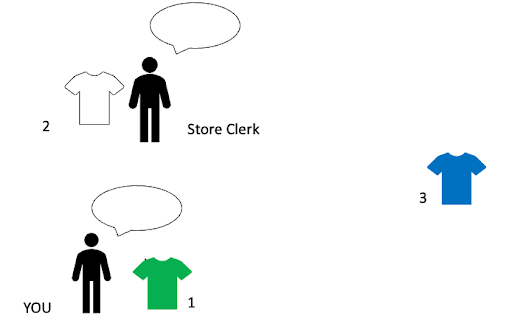
Let’s visualize this by imagining a scene in a clothing store:
See if you can figure out which t-shirt is indicated by each person in each sentence.
You:すみません、これはいくらですか。
Sumimasen, kore wa ikura desu ka.
Excuse me, how much is this one?
→ The t-shirt closest to you, the speaker, is shirt 1.
Store Clerk:それは1,000円です。
Sore wa sen en desu.
→ Since the clerk is speaking now, they’ll talk about shirt 1 using それ.
You:それはいくらですか。
Sore wa ikura desu ka.
→ Now we’re talking about a shirt closer to the store clerk, so shirt 2.
Store Clerk:これは1,500円です。
Kore wa sen gohyaku en desu.
→ Since shirt 2 is close to the store clerk, we they use これ when discussing it.
You:あれはいくらですか。
Are wa ikura desu ka.
→ Now we’re looking for a t-shirt that is far from both of you, so you’ll use あれ!
Store Clerk:あれは700円です。
Are wa nanahyaku en desu.
Don’t use demonstratives like these to refer to people in Japanese! So you shouldn’t introduce someone with これは[kore wa](this is…). If you do, it would sound very rude.
If you’re pointing to someone in a picture or something like that, you can use the polite demonstratives like こちら[kochira] to talk about people, though, because you are talking simply about the photos of people, not people themselves.
When to use この [kono], その [sono], and あの [ano]?
The Japanese demonstrative adjectives, この[kono], その[sono], and あの[ano] are used when words like “this,” or “that,” are used before a noun, to help you indicate one in particular. The distance rules, though, are the same as for the demonstrative pronouns we saw above!
| | |
| | |
| | far from the conversation |
Let’s look at some examples:
demonstrative adjectivenoun
Speaker A:このかばんは誰のかばんですか。
Kono kaban wa dareno kaban desu ka.
As for this bag, whose bag is it?
Speaker B:そのかばんはみちこさんのかばんです。
Sono kaban wa Michiko san no kaban desu.
That bag (by you) is Michiko’s bag.
Speaker A:(How about) that bag (over there)?
Speaker B:あのかばんはひろしさんのかばんですよ。
Ano kaban wa Hiroshi san no kaban desu yo.
That bag (over there) is Hiroshi’s bag.
Are there words for “these” and “those” in Japanese?
In Japanese, you can also use the words この[kono], その[sono], and あの[ano] to mean “these” or “those”: just use them before a plural noun!
The demonstrative pronouns この[kono], その[sono], and あの[ano] do have special plural forms: これら[korera](these), それら[sorera](those), and あれら[arera](those). However, they’re not often used in everyday speech.
How to ask a question with どれ [dore] or どの [dono]?
In Japanese, どれ[dore] and どの[dono] are both used to ask “which” questions. どれ[dore] is used if there is no following noun (e.g. “Which is cheaper?”) while どの[dono] is used when it’s followed by a noun (e.g. “Which book is cheaper?”)
Let’s look at how to structure the questions and answers themselves!
When the question starts with どれ [dore] or どの [dono]
When you start a question with どれ[dore] or どの[dono], the questioned word will always be followed by the particle が[ga]. For example, in a bookshop, you might ask:
どれがおもしろいですか。
Dore ga omoshiroi desu ka.
Which one is interesting?
どのペンが私のペンですか。
Dono pen ga watashi no pen desu ka.
You’ll generally want to use が[ga] after the answer to the question as well, as in:
これがおもしろいですよ。
Kore ga omoshiroi desu yo.
But if the answer is very simple, you may not need a particle.
When the question doesn’t start with どれ [dore] or どの [dono]
Sometimes, a “which one” question will actually start with a topic marked by the particle は[wa], which is then followed by どれ[dore] or どの[dono]. For example, you might ask instead:
おもしろい本はどれですか。
Omoshiroi hon wa dore desu ka.
(Speaking of) an interesting book, which one is it?
私のペンはどのペンですか。
Watashi no pen wa dono pen desu ka.
As for my pen, which pen is it?
You can answer these kinds of questions by just replacing the question word with an appropriate demonstrative:
おもしろい本はこれです。
Omoshiroi hon wa kore desu.
An interesting book is this one.
Or you might provide the sorts of answers we saw above:
これがおもしろいですよ。
Kore ga omoshiroi desu yo.
→ This puts a bit more emphasis on これ[kore], implying that they’re really pushing this book in particular.
How to say “here” and “there” in Japanese?
In Japanese, we use the words ここ[koko], そこ[soko], and あそこ[asoko] to point to places, like you might use “here” or “there” in English. If you want to ask “where?” or “what place?” you can use どこ[doko].
| | |
| | |
| | far from the conversation |
| | |
Let’s look at another scenario to practice using these demonstratives!
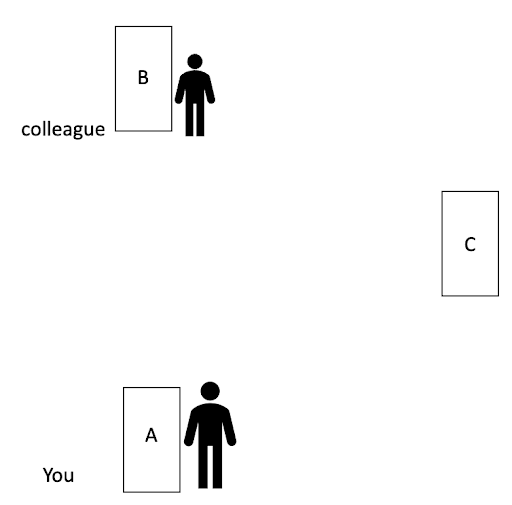
You and your colleague are in a room with three doors. You want to find the bathroom so you ask…
トイレはどこですか。
Toire wa doko desu ka.
As for the bathroom, where is it?
→ This is the usual way to ask something’s location. You’ll almost never start a “where” question with どこ[doko].
See if you can figure out, using the picture above, which door your colleague would be indicating with each possible answer:
Answer 1:→ It is far from your colleague, close to you (the listener) so… Door A!
Answer 2:→ It is close to your colleague (the speaker) so… Door B!
Answer 3:→ It is not close to your colleague (the speaker) or to you (the listener) so… Door C!
What are some other demonstratives in Japanese?
Though the demonstratives above are the most common, there are some other demonstratives in Japanese as well. These all use the same こーそーあーど pattern we saw above. Let’s have a look!
こちら [kochira], そちら [sochira], あちら [achira], and どちら [dochira]
The demonstratives こちら[kochira], そちら[sochira], あちら[achira] and どちら[dochira] are considered very polite. You can use them to refer to a place, a direction, or a person.
| | | |
| | | |
| | | |
| | | |
*When talking about directions casually, you can use the contracted forms, こっち[kocchi], そっち[socchi], あっち[acchi], and どっち[docchi].
Let’s see some examples:
Referring to places or directions
トイレはこちらです。
Toire wa kochira desu.
食堂はどちらですか。
Shokudō wa dochira desu ka.
そちらに行かないでください。
Sochira ni ikanaide kudasai.
Please don’t go that way.
Referring to people politely
そちらはどなたですか。
Sochira wa donata desuka.
こちらはジョンさんです。
Kochira wa Jon san desu.
Important!You can use this demonstrative to refer to people who are not present, like in a picture, but you shouldn’t refer to them this way in person. It’s considered rude!
こんな [konna], そんな [sonna], あんな [anna], and どんな [donna]
The demonstratives こんな[konna], そんな[sonna], あんな[anna] and どんな[donna] are used before a noun to refer to the kind of thing you’re talking about:
| |
| that kind of — (like the one by you) |
| |
| |
For example, you caught a big fish, and say,
こんな魚は見たことがない。
Konna sakana wa mitakoto ga nai.
I have never seen a fish like this.
If you want to ask what kind of food the listener likes, you may ask,
どんな食べ物が好きですか。
Donna tabemono ga suki desu ka.
What kind of food do you like?
こう [kō], そう [sō], ああ [ā] and どう [dō]
The demonstratives こう[kō], そう[sō], ああ[ā] and どう[dō] represent the manner in which something is done.
| |
| like that (how you’re doing it) |
| like that (how he/she is doing it) |
| |
For example, if I want to show someone how to write a particular kanji, I may write it on a piece of paper and show how it is written. As I write it, I would say,
(We) write (it) like this.
If that person I’m talking about starts writing the kanji incorrectly, I might say,
(We) don’t write (it) that way.
Let’s say another person is writing the kanji correctly on the whiteboard, which is not close to either me or the listener. I would point at that kanji and say,
(We) write (it) that way.
As you might have guessed, どう[dō] is a question word asking a manner in which an action is taken:
How to use Japanese demonstratives to talk about the past?
In Japanese, you can also use demonstratives to talk about a past time or situation, much like you might refer to “that day” or “that vacation” in English. To do this in Japanese, you’ll use either the そ[so] demonstratives and sometimes use the あ[a] demonstratives.
Usually you’ll use the そ[so] demonstratives are used when you are referring to a specific time, thing or place that is new information to the listener; the listener was not a witness to the past situation:
きのう、部屋で友達とテレビを見ていたんです。その時、大きい音がしてびっくりしました!
Kinō heya de tomodachi to terebi wo miteitandesu. Sono toki, ōkii oto ga shite bikkuri shimashita!
I was watching TV with my friend in my room yesterday. At that time, there was a loud sound, and we were startled!
→ The listener was not present or aware of the events.
On the other hand, you’ll use the and the あ[a] demonstratives are used when the speaker and the listener share the same knowledge, usually because the listener was also there to experience the past situation:
Michiko:先週のキャンプはおもしろかったね。
Senshū no kyanpu wa omoshirokatta ne.
Last week’s camping was fun, wasn’t it?
Takeshi:うん、あのキャンプ場はきれいだったね。
Un, ano kyanpu jō wa kireidatta ne.
Yes, that campground was beautiful.
Michiko:うん、またあそこに行きたいなあ。
Un, mata asoko ni ikitai nā.
Yes, I would like to go there again.
To sum up
In this article, we looked at how to use a variety of Japanese demonstrative words. These are “pointing” words that help you pick out which thing, time, person, place, etc. you’re referring to.
The most important thing to remember is this basic table:
| | | |
| | | |
| far from the conversation | | |
| | | |
Remember, also, these broad categories of demonstratives:
これ[kore] etc. → used alone, as a stand-in for the noun
この[kono] etc. → used before a noun, to indicate which one
ここ[koko] etc. → used for places
こちら[kochira] etc. → very polite and used for places, people, or directions
こんな[konna] etc. → used to point out “what kind” of thing (e.g. “this kind of…”)
こう[kō] etc. → used for the manner in which something was done (e.g. “this way”)
Now, it’s time to try out our Japanese demonstratives exercises, to test your skills! Happy learning!
To embark on your next language adventure, join Mango on social!