How does の [no] express possession?
When you’re using の[no] to express possession, you simply place の[no] between the two noun phrases you want to connect. The first noun is the “possessor” or “owner” noun, while the second is the “possessed.”
この漫画の主人公が好きです。
Kono manga no shujinkō ga suki desu.
I like this manga’s main character.
友達の弟は15歳になりました。
Tomodachi no otōto wa jūgo sai ni nari mashita.
(My) friend’s younger brother turned 15.
You could translate the sentences above using “of” as well, as in “the main character of this manga” or “the younger brother of my friend.” However, the word order in Japanese matches the word order of the possessive -’s, so it can be easier to use that translation when you have a choice!
Japanese doesn’t use possessive words like “my,” “your,” or “their.” In Japanese, we just use this same structure with の[no] even when a pronoun is the possessor. For example:
pronoun
それは私の本です。
Sore wa watashi no hon desu.
→ 私[watashi](I) is used before の[no]. There is no special form meaning “my.” It’s more like saying “That is the book of me.”
We do the same thing to create other phrases that would be represented using possessive words like “whose” or “their” in English.
pronoun
誰の本ですか
Dare no hon desu ka
→ Compare: “This is the book of who?”
As you can see from some of the examples above, just like in English, the possessive relationship drawn using の[no] is not always one of ownership. It can express many other relationships of more abstract “belonging” as well. Let’s have a look!
What kinds of relationships can の [no] indicate?
The Japanese particle の can be used any time something “belongs” to something else, but that “belonging” is not always as literal as ownership.
Let’s have a look at some examples of the types of relationships you may use の[no] to describe. These should all be pretty familiar from English:
| それは私の本です。 Sore wa watashi no hon desu. |
Close personal relationship | 健二の家族は千葉に住んでいる。 Kenji no kazoku wa Chiba ni sundeiru. Kenji’s family lives in Chiba. |
Affiliation X is a member of Y | 佐藤さんはマンゴー大学の学生です。 Satō-san wa Mangō daigaku no gakusei desu. Ms. Sato is a student of Mango University. |
Part of a whole X is a piece of Y | ワシントンDCはアメリカの首都だ。 Washinton diishii wa Amerika no shuto da. Washington DC is the capital of America. |
| 先週、歴史の本を買いました。 Senshū, rekishi no hon o kaimashita. I bought a book about history last week. |
| その木の椅子に座ってください。 Sono ki no isu ni suwatte kudasai. Please take a seat on that wooden chair. |
Location X is in the direction of Y | 郵便局はあの本屋の右にあります。 Yūbinkyoku wa ano hon’ya no migi ni arimasu. The post office is to the right of that bookstore. |
| まだ村上春樹の本を読んだことがない。 Mada Murakami Haruki no hon o yonda koto ga nai. I have never read a book yet (written) by Haruki Murakami. |
Let’s talk a little more about the “material” relationship. You can also use the particle で[de] to indicate the material an object is made of. See if you can spot the difference between the two, though, in the examples below.
木の椅子に座ります。
ki no isu ni suwarimasu.
I will sit on the wooden chair.
木で椅子を作ります。
ki de isu o tsukurimasu.
I will make a chair (out) of wood.
Did you see it? We used の[no] to describe the existing material of the chair, while で[de] is used to plan the construction of a chair. So we use で[de]when discussing creating some object out of some material, but の[no] if we’re just discussing an existing object.
Embedded possession: When to use の [no] more than once?
If the possessor is also possessed, you will want to use の[no] more than once as well! This means that for every “possessor” in a phrase like “the teacher’s son’s classmate’s little sister’s cat” will require its own の[no]. Let’s have a look at an example:
Two possessors:先生の息子の猫
sensei no musuko no neko
Three possessors:先生の息子のクラスメイトの猫
sensei no musuko no kurasumeito no neko
the teacher’s son’s classmate’s cat
Four possessors:先生の息子のクラスメイトの妹の猫
sensei no musuko no kurasumeito no imōto no neko
the teacher’s son’s classmate’s little sister’s cat
When to leave out possessive の [no]?
The particle の[no] is always necessary if you’re expressing a generic possessive relationship. However, we sometimes leave it out if a possessive phrase is used to name something.
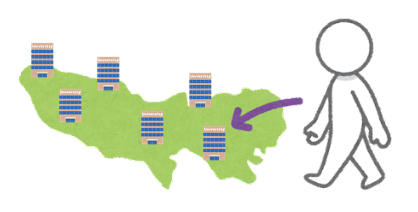
For example, if you wanted to talk about a university in Tokyo, you would use の[no], as in…
a university in Tokyo,
universities in Tokyo
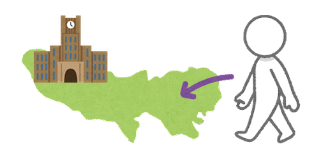
However, the name of the specific institution the University of Tokyo, does not include の[no]. So even though the same possessive relationship is understood, we don’t actually use the particle.
University of Tokyo
Tokyo University
So when your friend says they go to 東京の大学[Tōkyō no daigaku], it can be any university located in Tokyo, and not specifically the prestigious national university!
What are some common mistakes with possessive の [no]?
The most common mistake that English speakers make when learning to use possessive の[no] relates to the word order. On its surface, the particle の[no] is very similar to the word “of” in English. However, when you use “of” the order of the possessor noun vs. possessed noun is the opposite that we see with の[no] in Japanese.
For example, imagine you want to say “I come from Chicago, Illinois” in Japanese. Which of the following word orders would you use?
イリノイのシカゴ出身です。
Irinoi no Shikago shusshin desu.
シカゴのイリノイ出身です。
Shikago no Irinoi shusshin desu.
Right, sentence A is correct! Because Chicago is located in Illinois, Chicago “belongs to” Illinois. So, following the Japanese rule, the possessor, Illinois, comes first.
If you start to feel confused, the simple way to remember the right word order is to think of の[no] as being like the possessive ’s. Then you won’t have any problem with the word order: Illinois’ Chicago!
How to use の [no] to mean “one”?
The particle の[no] can also be used as a stand-in for a noun in much the same way you use the word “one” in English phrases like “a pretty one” or “the one that is sitting by the stove.” In this case, の[no] functions as a pronoun, even though it’s still considered a 助詞[joshi](particle) in Japanese.
Unlike “one” in English, the Japanese word の[no] should usually not be used refer to a person. It’s considered derogatory. While you may see expressions like 若いの[wakai no](the young one/ones) or ちっこいの[chikkoi no](the short/little one) used to refer to people in media like manga, in real life they can be considered insulting.
To use の[no] to mean “one,” simply place の[no] after the or that describes it:
As long as you have a description before it, の[no] acts like a noun and the rest of the sentence can continue as if the noun it stands for was there. Let’s look at some examples!
adjectiveの (no)
Rental car agent:どの車を借りますか。
Dono kuruma o karimasu ka.
Customer:あの赤いのをお願いします。
Ano akai no o onegaishimasu.
→ Notice that the
object marker particle を[o] follows
の[no] just like it would have followed
車[kuruma](car) if you’d used that instead!
clauseの (no)
Masaru:このケーキはおいしくないね。
Kono kēki wa oishiku nai ne.
This cake doesn’t taste good, don’t you think?
Tomoko:昨日食べたのはおいしかったのに。
Kinō tabeta no wa oishikatta noni.
But the one we ate yesterday was good.
Can you tell the difference between the two different uses of の (no)? What do the two sentences below mean?
あの車は私のです。
Ano kuruma wa watashi no desu.
私の車は赤いのです。
Watashi no kuruma wa akai no desu.
Answers: Sentence (1) means “That car is mine” and sentence (2) means “My car is the red one.”
Bonus: How to use の [no] to mean “which is”?
The Japanese particle の[no] can also be used to link a noun with something that we consider to be the same, sort of like you might use the phrase “which is” or “who is” in English. For example:
はじめまして、部長の田中です。
Hajimemashite, buchō no Tanaka desu.
Nice to meet you, (I am) Tanaka, (who is) the manager.
Notice, though, that the word order is reversed. So where, in English, you say “Tanaka, who is the manager” in Japanese, you would say “the manager の Tanaka.”
In this use, the particle の[no] can be combined with another particle, which will usually precede の[no]. Here are some particles that can combine with の[no]:
| 空港で友達へのおみやげを買いました。 Kūkō de tomodachi e no omiyage o kaimashita. I bought souvenirs (which are) for a friend at the airport. |
| 図書館での飲食は禁止です。 Toshokan de no inshoku wa kinshi desu. Eating and drinking (which is) in the library, is not allowed. |
| 午前中だけのアルバイトを探しています。 Gozenchū dake no arubaito o sagashiteimasu. I am looking for part-time jobs (which are) only in the morning. |
Even though へ[e] and に[ni] are often used interchangeably, we do not say にの[ni no]. If you want to use に[ni], simplify things and just say:
友達におみやげを買いました
Tomodachi ni omiyage o kaimashita.
I bought souvenirs for a friend at the airport.