You may have heard that Mango languages uses real voices in our core courses. Whether you're learning Spanish, Irish, Potawatomi, or even "Pirate," if you're looking at this kind of screen, you can feel confident that there is a real human on the other end of the microphone.
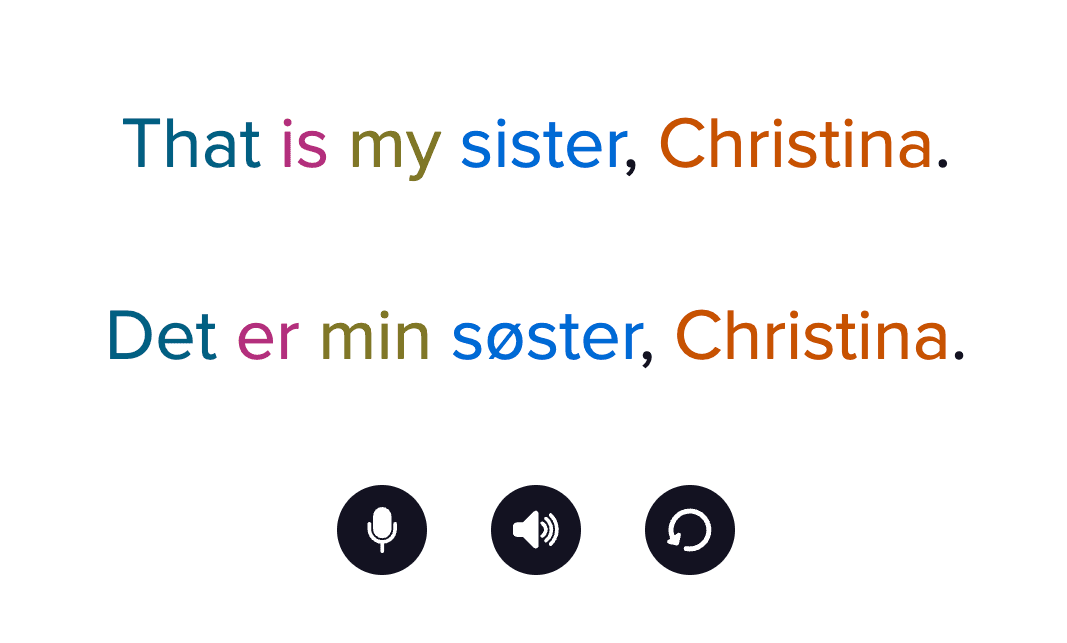
We're often asked why that is. These days, artificial voices are getting a lot better, sometimes to the point where it's hard to tell what's "real" and what's "fake." So why does it matter whether the voice is human or machine made?
In this post, we'll walk you through why we think listening to the voices of real people is still the best way to learn a language, and why we have continued to rely on human voices in our core features.
Why are human voices so great?
The main reason we continue to rely on real voices at Mango is that real voices still provide more reliably high quality pronunciations.
Text-to-speech struggles with some languages.
These days, English text-to-speech can sound almost like a real voice. But that's not true in every language!
When we look at lesser-resourced languages, like Tuvan or Potowatomi, text-to-speech tools will make a lot of mistakes and may not even work at all.
Even in well-resourced languages, though, text-to-speech tools sometimes struggle with ambiguous words and may make mistakes with secondary features of pronunciation, like stress or intonation.
For example, a text-to-speech tool might not correctly capture the differences in intonation between the two questions below:
How do you say 'apple' in Spanish?asking for the first timeHow do you say 'apple' in Spanish again?looking for a reminderLanguage teachers can fix some of these mistakes by editing the text-to-speech output by hand, but it still usually sounds more natural for a human to read it.
Real humans are still more entertaining and unique.
There is a "magic" and an unpredictability that real human voices can bring to a course that is just hard to capture with a text-to-speech engine. If you've used one of our reading and listening passages, you'll know that some of our voice actors can really use their voices to tell a story, and that makes learning more fun!
Humans are the best at capturing speech styles.
In every language, people sometimes speak fast and sometimes speak slow. You might want to use "baby talk" in some cases, or put on a "big bold" voice in others. These sorts of speech styles aren't done exactly the same way in every language, so learning to use them is important. Native speakers have the best intuitions on how and where to use them, and can switch between them seamlessly.
We've listened to what our users value.
We've listened to your feedback on social media, in app reviews, and at conferences, and it's clear to us that real and authentic language learning tools are something learners want.
We want you to feel comfortable and confident that what you're learning is accurate, so we continue to use the native speakers whose voices you've grown to trust!
Who are our native speakers?
The voices that you hear in the core Mango lessons are all real people who are native speakers of the language or dialect you're learning. But where do they come from? Who are they?
The voices you'll hear on most of our courses are professional actors. Many of them have careers on Broadway, in television, or in movies. So if you use Mango a lot, keep an ear out for a familiar voice in a commercial or in an episode of your favorite TV show!
If you're learning one of our endangered languages, chances are that the person you're listening to is someone who the speaker community helped us select as a language ambassador. It's important that endangered languages be represented by the most fluent speakers possible!
How do we pick our voice actors?
When we need to pick a new voice to use in our courses, our recording studio sends us a variety of options. Our language teachers review samples of each voice to help us pick just the right one to represent our course. This means that you can be sure that you're learning from someone who speaks the right dialect and whose pronunciation is excellent!
We have long-term contracts with our main Mango voice talent. That way, when we want to make revisions to a course, we can call in our original voices to record some more lines of dialogue for us. Many of our voices have been working with us for over a decade.
How to take advantage of our real voices?
Want to take full advantage of all our voice actors have to offer? Make sure to use these features of the app!
Compare the "connected" and "isolated" pronunciations.
We record the sentences in our lessons twice. First, the actor reads the whole sentence all together, then they read through each word in isolation. Click the play button to hear the whole sentence, and click each word to hear its isolated pronunciation. Doing this can help you practice your pronunciation, while also helping you notice the differences between careful speech and connected speech in the language you're learning.
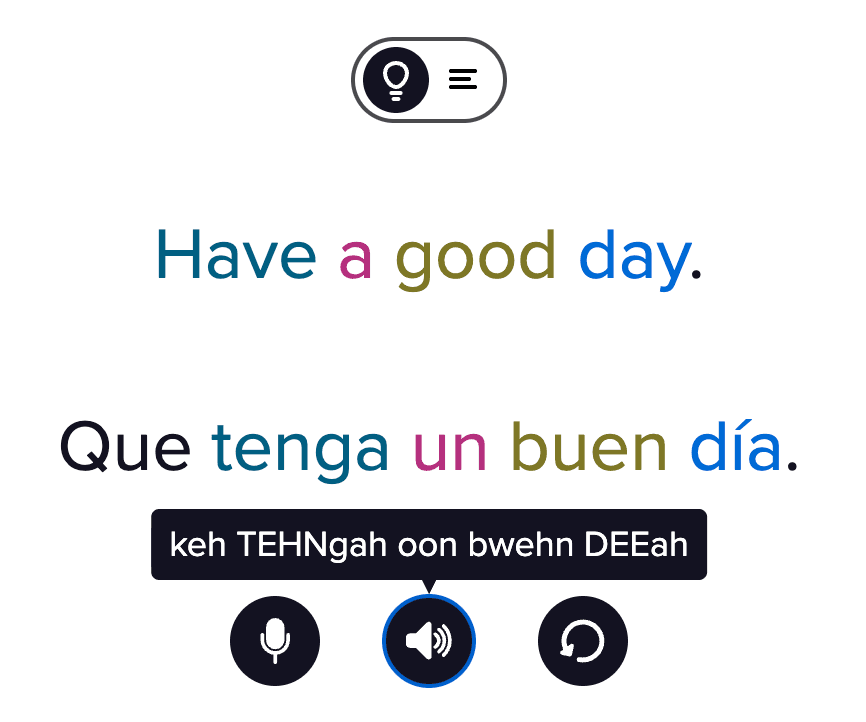
Click the speaker for connected speech
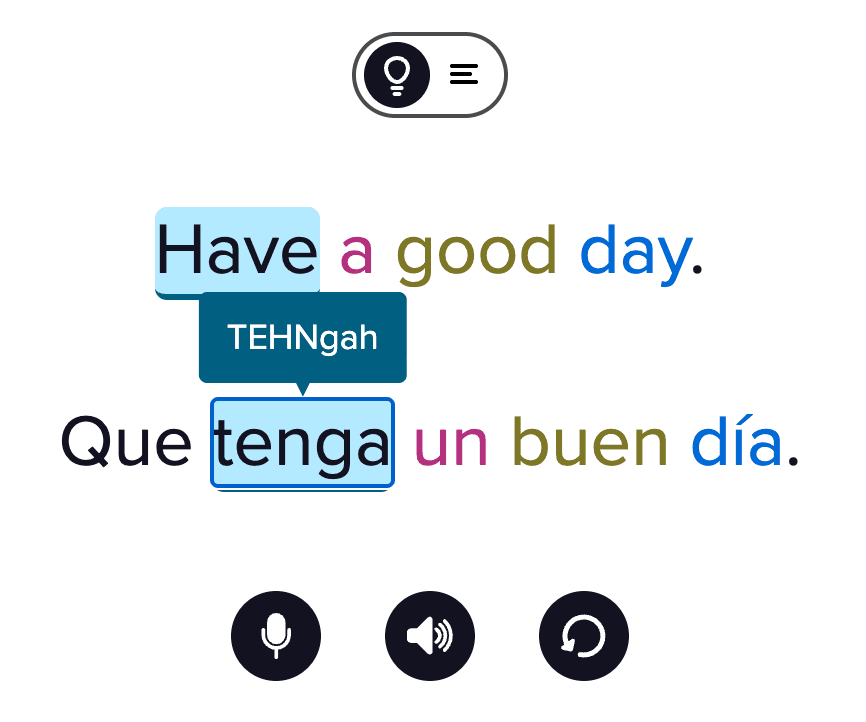
Click the word itself for careful speech
Use the voice compare feature.
Click the microphone icon in our main courses to visually compare your pronunciation with a native speaker's! This visualization can especially help you spot differences in timing, stress, and consonants.
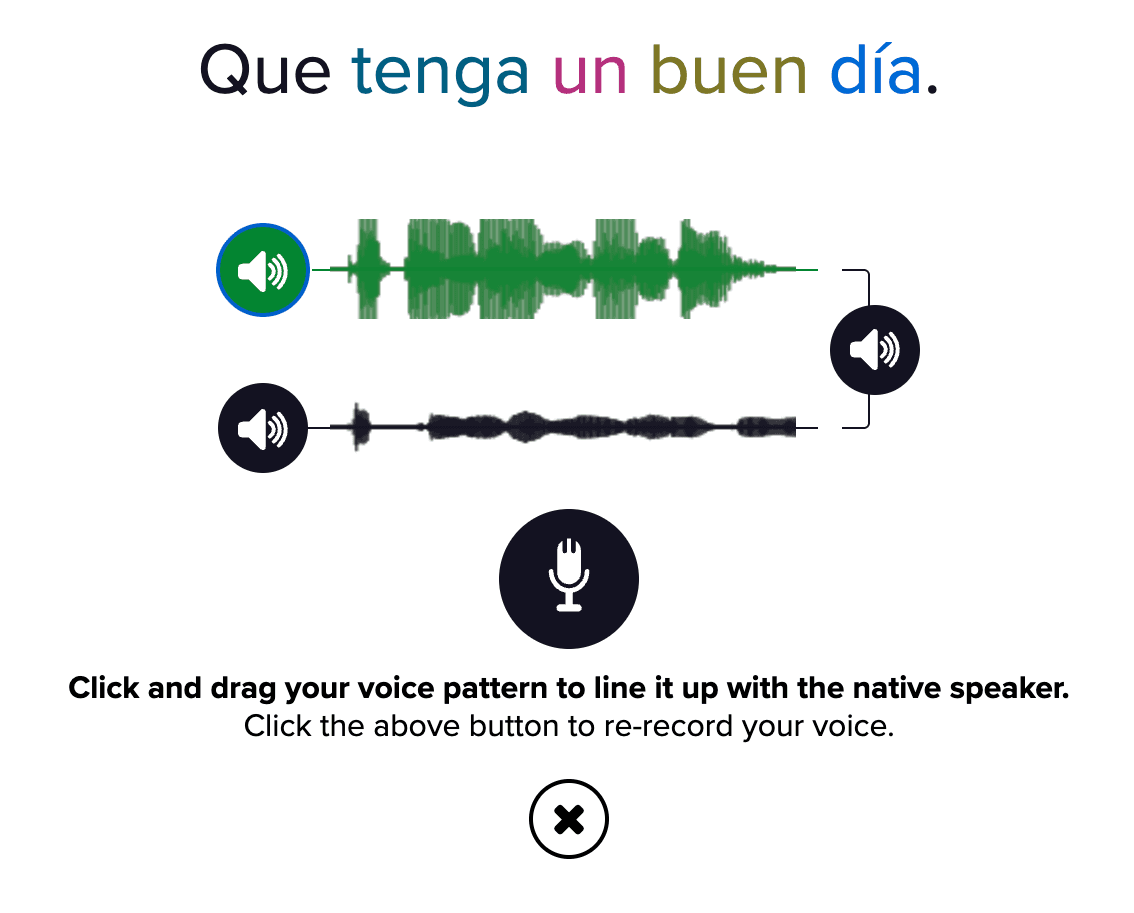
Check out our reading and listening passages.
Our reading and listening passages are where our voice actors really shine! These longer-form stories or dialogues really showcase more natural speech in different contexts and modalities, so you can use these passages to get a clearer idea of what casual pronunciation might sound like in the real world, spoken by a native speaker.
Does Mango ever use AI voices?
At Mango, we use real actors in our central lesson materials. For the reasons above, we believe this still results in the best quality learning materials.
However, we do use AI voices in some of the materials that supplement our core lessons. Using these tools lets us adapt quickly and lets you customize your learning. Unlike a recording studio, an AI voice can respond to a need right away. Even if it's not perfect, it can give you the right pronunciation most of the time, and that's way better than no help at all!
Here are a few examples of where you might encounter AI voices while using Mango:
When you add your own words to your custom My Vocabulary lists to study later, we automatically add text-to-speech audio for each word. You might also hear text-to-speech in some of our curated Mango Vocabulary lists.
In reading-focused tools like our interactive reading passages or Mango reader, we provide text-to-speech audio. This allows you to have some pronunciation support while you practice reading.
Occasionally, we will use text-to-speech as an "emergency fix" when we discover an issue in one of our core courses. That way the course stays accurate until we can get one of our voice actors into the recording studio. If we do this, the pronunciations are always checked by one of our teachers, and we revise them the next time our human voices have availability.
In all these cases, we still include native speakers in the process. They help us evaluate the general accuracy of our text-to-speech tools, select the best voices to use for each language, and may provide feedback on mispronunciations coming from the tools.
Want to learn more about how and when Mango uses AI? Check out our statement on Mango's general approach to AI tools.
:quality(80))
:quality(75))
:quality(75))
:quality(75))
:quality(75))
:quality(75))
:quality(75))